Why use Yank over AI platforms?
Fair question. You can paste an article into ChatGPT, ask for the five most important parts, and get five good ones. You can ask it for shareable cards and get attractive cards. We know, because we did exactly that, then asked ChatGPT whether it had just made Yank redundant. Its answer is further down, unedited.
The experiment
On 10 September 2026 we gave the same New York Post article, about a former Anthropic researcher’s warning on AI, to both.
ChatGPT returned five accurate, well-written points. Asked for cards, it produced five illustrated graphics with headlines, expanded prose, a generated face for the researcher, and the New York Post’s logo.
Yank returned this page: three verbatim lines and two distilled ones, each labelled as which, each with where it sat in the article and which interview it came from, on cards that carry the author’s name and a permanent address. No face was drawn and no logo was borrowed.
Then we checked Yank’s page against the article. All three verbatim lines are in it, word for word.
What is actually different
- The words. ChatGPT paraphrases. A Yank line marked verbatim was found in the source mechanically, after the model chose it, and a line that fails that check is demoted to distilled and says so.
- The location. A Yank line tells you where it came from, a timestamp, a page or a place in the article, and opens the surrounding context. A summary cannot be checked without re-reading the source.
- The refusal. Yank has a rule at the product level: five useful, source-backed lines without padding, or no artifact at all. A general-purpose chat has no equivalent requirement unless you ask it to follow one.
- The address. A public Yank is a permanent page in a searchable library, on the source’s own feed, built to stay useful outside the conversation that made it. A chat answer lives inside its conversation.
- The receipt. A Yank card says what kind of claim it is making: verbatim or distilled, where it was found, what surrounded it. So when Yank is wrong, it leaves enough evidence to prove it. The next section is an example.
In ChatGPT’s own words
Asked whether its output made Yank unnecessary, ChatGPT wrote the following. Nothing has been changed except cutting the parts that were about our internal notes.
My response was genuinely useful: you gave me an article, I identified five important points, then turned them into attractive social cards. For a casual user whose goal is simply “save me time and give me something shareable,” that absolutely overlaps with Yank. We shouldn’t rationalize that away.
But look at what happened when you asked me to create the cards. I took another generative step. The resulting graphic contained expanded explanatory prose, imagery, attribution/branding and presentation choices that were generated around my interpretation of the article. The artifact became progressively farther removed from the underlying evidence.
ChatGPT can generate the five. Yank can make the five defensible.
ChatGPT: “Here are five important things.”
Yank: “Here are five important things, exactly what kind of claim each is, where each came from, what was actually said versus distilled, and the receipt to challenge me.”The existential threat is real if Yank is merely a five-point summarizer with nice cards. That product will get swallowed by ChatGPT, Claude, Gemini and whatever comes next. But if Yank becomes the evidence layer for information worth keeping, then improvements in general-purpose AI can actually help Yank. Better models improve candidate selection and extraction while Yank owns the deterministic verification, receipts, permanent objects, corpus, repeated-source evidence and eventually the historical evidence graph.
“These words occur in the source” is not the same claim as “this person said these exact words.” If Yank can systematically distinguish those, that’s not cosmetic differentiation. That’s trust infrastructure.
ChatGPT, asked by Yank’s founder whether it had made Yank redundant, 10 September 2026
The receipt to challenge us
That last paragraph is about a flaw the experiment found in Yank, and it is worth being plain about. One of the three verbatim lines on that page is a sentence the Post wrote in reported speech: “…could happen in roughly six months, he told Baier.” The words are in the article, exactly, so the check passed. But the card puts them in quotation marks under the researcher’s name, and the article never does. Those are the publication’s words about him, not his.
We have not fixed that yet. It is logged, and the fix is an attribution rule, not a prettier card: a person’s name appears as the speaker only when the source establishes that the words are theirs, whether that source is an article, a transcript or a scanned page. We are telling you because you could only have caught it on a Yank. The location and the context are on the card; a summary would have given you nothing to check. Yank’s advantage is not that it cannot be wrong. It is that when it is wrong, it leaves enough evidence to prove it.
A second case, from a phone
This one was not a controlled experiment. It was a Thursday night on a phone: the same Instagram reel, an ABC World News Tonight clip, pasted into ChatGPT and into Yank.
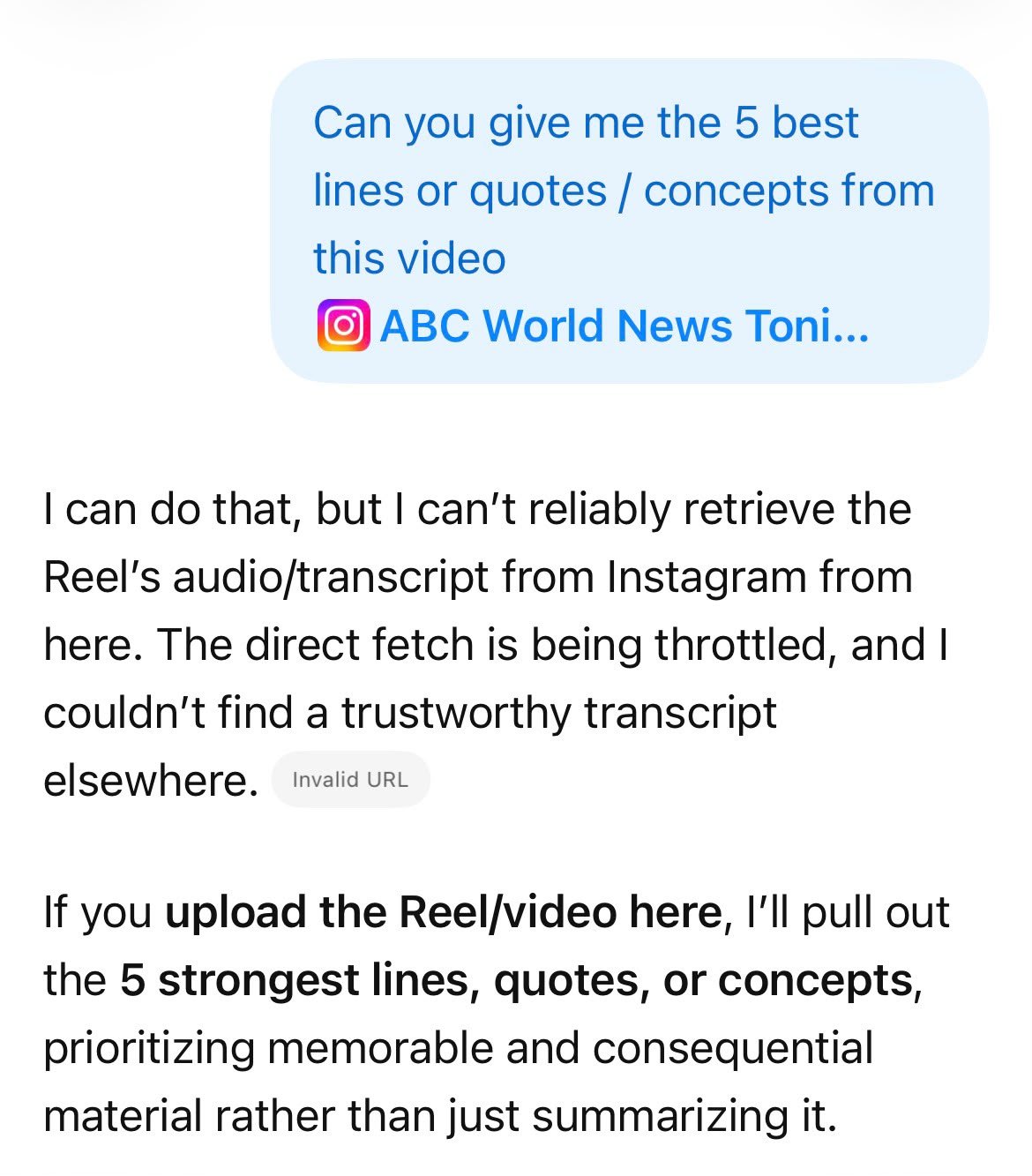
ChatGPT said it could not reliably retrieve the reel’s audio or transcript, that the direct fetch was being throttled, and asked for the video to be uploaded instead. Yank read the reel, transcribed the audio, and put five located lines at a permanent address. On the day it took 28 seconds. The night before, the transcription provider’s queue had held the same reel past Yank’s limit and that attempt failed; the wait is reported now, and a timed-out job says to try the same link again rather than a different one.
The caveat belongs on the page too. A reel has no captions, so the transcript is generated from the audio and the card says exactly that. The lines are located to the second, but the words are a machine’s hearing of them, and the receipt is the timestamp, not a publisher’s text. That is a weaker receipt than an article gives, and it is still a receipt: you can open the reel at that second and listen.
One more thing, stated carefully. Purpose-built tools already caption an uncaptioned reel while you watch it, and they do that job better than Yank ever will. What Yank adds is different: for readers who don’t use audio, it turns the reel into five readable, timed lines that can be kept and shared. It is not a replacement for captions or a full transcript. Captions make the video readable. Yank makes what is worth keeping portable.
When to use the chat instead
When you want a conversation: follow-up questions, a different angle, a rewrite for a particular audience, an illustration. Those are things a chat does well and Yank does not do at all. Yank does one thing: five lines you can defend, connected to the evidence behind them, at a permanent address, in ready-to-share form. To keep, or to share with whomever you want.
How the lines are chosen and checked is on How it works. What Yank is, in short, is on About.